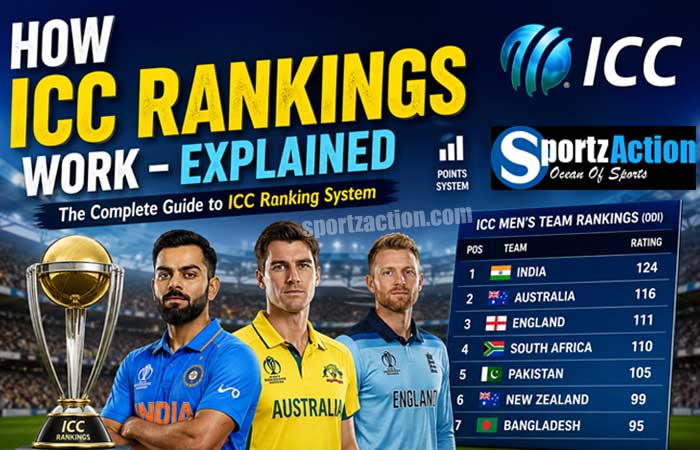
Learn how ICC cricket rankings work, how points are calculated for teams and players, and what affects ranking movements across formats.
Introduction
Cricket fans often debate which team or player truly deserves the top spot and this is where the ICC Cricket Rankings come into play. The ICC ranking system is designed to provide an objective measure of performance across international cricket, covering Tests, ODI and T20 Internationals. Rather than relying on reputation or isolated results, the rankings reward consistency, quality of opposition and match impact reflects.
Check out : ICC Cricket Rankings
To understanding how ICC rankings are calculated helps fans follow the game more closely and makes ranking changes easier to interpret. This guide breaks down the ICC Cricket Rankings in simple terms, explaining the points system, key concepts and common misunderstandings so even Cricket beginners can grasp how it all works.
Background and History of ICC Cricket Rankings
The International Cricket Council (ICC) introduced official rankings to bring a structured and objective system to evaluate team and player performances. Before rankings existed, comparisons were mostly subjective and based on reputation or series outcomes.
Over time, in this ranking system evolved to reflect consistency rather than one-off results. The goal was to reward teams and players who perform well over a period, rather than those who win occasional matches also. As cricket expanded globally and formats diversified the ICC refined the ranking system separately for Tests, ODIs and T20Is to ensure fairness across three formats.
Also Read: ICC Test Team Rankings
Today, ICC rankings are widely accepted as the standard benchmark for international cricket performance as well.
Key Concepts Behind ICC Cricket Rankings
What Are Rating Points?
Rating points are like numerical values assigned to teams or players based on match results and individual playing performances. These points determine a team’s or player’s position in the rankings table. A higher rating means stronger performance over time.
Ranking vs Rating
- Ranking refers to the position (1st, 2nd, 3rd, etc..)
- Rating refers to the numerical score used to determine that position
Two teams may be close in ranking but separated by only a few rating points.
How ICC Team Rankings Work (Step-by-Step)
Step 1: Match Results Are Assigned Weight
Each match carries a certain weight depending on:
- Format of the game
- Strength of the opposition
- Match outcome (win, loss, or tie)
Beating a higher-ranked team earns more points than defeating a lower-ranked side.
Also Read: ICC Women’s Team Rankings
Step 2: Points Are Awarded After Every Match
- Whether they win, lose or draw
- The relative ranking of their opponent
For example:
- A lower-ranked team beating a top-ranked team gains extra points as total.
- A top-ranked team losing to a weaker side may lose more points.
Step 3: Ratings Are Updated Using a Weighted Average
The ICC uses a weighted average system where:
- Recent matches carry more value
- Older matches gradually lose importance
This ensures rankings reflect current performance trends rather than historical success alone.
Step 4: Series Results Are Factored In
In Test cricket match results play a significant role in the ranking. Winning a series away from home or against a strong opponent can boost ratings more than a home series match win.
Step 5: Rankings Are Calculated
Total rating points are divided by the number of matches played to calculate the final rating. Teams are then ranked from highest to lowest rating.
How Player Rankings Are Calculated:
Batters earn points based on:
- Runs scored
- Match situation
- Quality of opposition bowling
- Match format
Scoring more runs against a strong bowling attack team earns more points.
Also Read : Largest Cricket Stadiums in the World
Bowlers are ranked based on:
- Wickets taken
- Economy rate
- Match impact
- Strength of opposing batters
A five-wicket haul against a top batting lineup is highly rewarded as points.
All-rounders earn combined points from:
- Best Batting performance
- Best Bowling performance
Consistency in both batting and bowling departments is crucial for a high ranking.
Important Facts and Records Related to ICC Rankings
- The No.1 ranking is often considered an unofficial world champion status.
- Teams with long periods at the top usually show strong consistency.
- Player ranking stats can change quickly, especially in limited-overs formats.
- Test rankings tend to be more stable due to fewer matches.
- T20 rankings may be fluctuate more because of frequent matches and shorter formats.
Common Misconceptions About ICC Rankings
Rankings Are Based Only on Wins
This is not true. The quality of opposition and match context matter greatly.
Rankings Never Change Quickly
In limited-overs cricket, rankings can change rapidly due to more frequent matches and high weighting of recent playing performances.
Home Wins and Away Wins Are Equal
Away wins usually carry more weight because they are harder to achieve the target.
Player Rankings Depend Only on One Match
One outstanding performance helps, but sustained consistency is more required to stay highly ranked.
Frequently Asked Questions (FAQs)
1. Why do recent matches matter more in ICC rankings?
Recent matches better reflect a team’s or player’s current form and making rankings more accurate.
2. Are ICC rankings updated after every match?
Yes, rankings are updated regularly as new match results are added.
3. Do bilateral series affect rankings?
Yes, bilateral series results significantly impact rankings across all the formats.
4. Why are Test rankings more stable than T20 rankings?
Test matches are fewer and carry long-term weighting, while T20 matches are frequent and shorter formats.
5. Can a team top rankings without winning tournaments?
Yes, consistent performance across matches and series can result in a top ranking even without tournament wins.
Conclusion
The ICC Cricket Rankings are more than just numbers on a table. They reflect long-term performance, discipline and adaptability across different formats of the game. By factoring in match results, opposition strength and recent performances, the ranking system aims to present a fair picture of where teams and players stand in international cricket.
For Cricket fans, understanding the rankings adds depth to following the sport. Especially when tracking how teams rise or fall after key series and tournaments. While comparing there is no system is perfect, the ICC rankings remain one of the most reliable tools for comparing performance in modern cricket and appreciating consistency at the highest level.
Get more Cricket News and ICC Rankings. Keep Connect with SportzAction.com.